Phoenix · Las Vegas · Houston · Dallas–Fort Worth · Denver · Philadelphia
One good flip is luck. Doing it every week is a business.
Liquidation warehouses near you sell returns and overstock at daily auctions
for a fraction of retail. The lots aren't the edge — everyone in your city sees the
same ones. HustleBid prices each one against what it actually sells for, tells you the most
you can pay and still make money with fees and tax counted in, and tracks what really earned,
so month three isn't a rerun of month one's mistakes. Run it on evenings and weekends or
full time — the method is the same.
Bought it for $1.25.
Sold it for $26.
HUANUO under-desk keyboard tray
Return on what it cost
20.8×
All in — hammer, premium and tax.
— · In-person pickup only ·
Every number on this page came out of one operator's own books.
Actual flips, not screenshots of someone else's
Six lots bought at auction and sold locally. Cost is what was actually paid,
all in — hammer price plus the buyer's premium plus sales tax. Sale price is what a
buyer handed over.
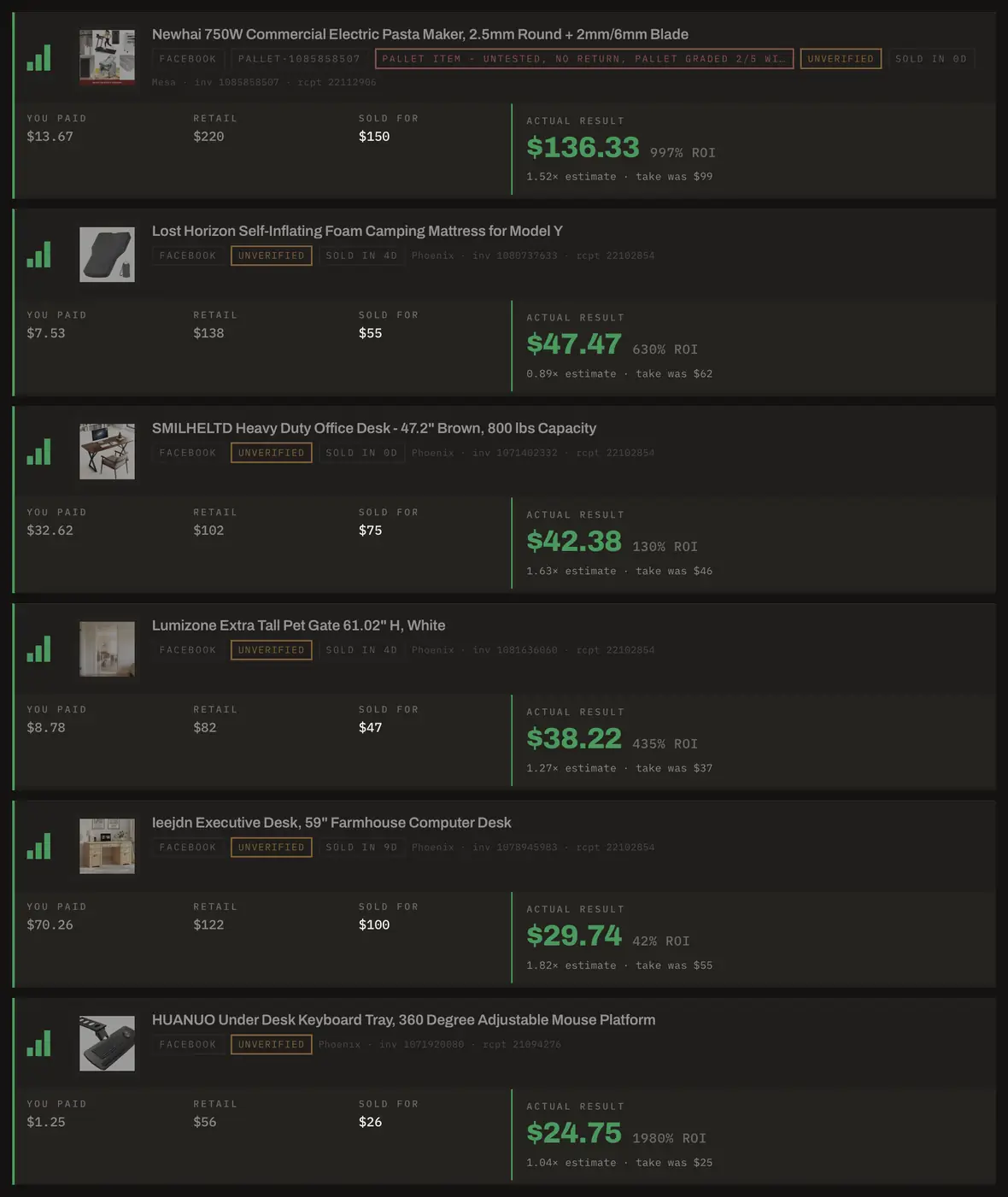 The ledger those numbers come out of. Cost is all-in — hammer price,
buyer's premium and sales tax — and the profit column is what was actually left.
Nothing on this page is typed by hand into a spreadsheet.
22 of the 47 sold the same day they were listed.
Not eventually. The same day. That is what it looks like when the price was already
right before the bid went in — you are not waiting on the market to come to you,
because you never paid enough to need it to.
47lots sold
22sold the same day they listed
1.00×median sale price against asking price
15sold for more than the asking price
Nobody loses money at auction because they couldn't find the lots
Everyone in your city sees exactly what you see. The lots were never the edge.
You lose money in three places, and all three happen before the hammer drops.
The retail price is a story
That $200 "suggested retail" was written by someone with no reason to be careful.
Bid against it and you have paid a real $40 for an imaginary $200.
Your $9 bid is not $9
Premium and local tax land after you have already won. Most people do that arithmetic
in the parking lot, which is roughly a week too late.
You buy what you like
The thing you would want in your own house and the thing that sells in four days are
rarely the same object, and nothing on the lot page tells you which one you are looking at.
Most people who quit this did not get unlucky. They overpaid four times,
ran out of cash before they ran out of enthusiasm, and never found out which four.
There are thousands of lots open right now.
You are not going to read them.
Live count across the six metros with a warehouse. Every one of them closes
within days, and a new load lands behind it.
Tonight's board. NOW is the live bid, MAX BID is your ceiling,
STREET is what the thing actually sells for — and the line underneath each one
is why. Read the first card: five of them are open at a dollar, and it tells you to take
one or two, not five.
The desk reads all of them overnight,
prices each against what the thing actually sells for, and hands back one number per lot:
the most you can bid and still make money after the buyer's premium and your local tax.
Above that number you walk. That is the entire discipline, and it is the part nobody
does by hand at three in the morning.
- ScanEvery open lot in your warehouse, filtered down to the ones where the
numbers work — not the fourteen search terms you remembered to check.
- Set a ceilingA hard maximum bid that still leaves your margin after premium
and tax. Above it, you walk. No exceptions and no feelings.
- Pick up and listPhotos, title and description written for you. Cash, local
pickup, no shipping, no boxes.
- Bank itLog the sale. The desk learns what actually earns in your market and
what to stop buying.
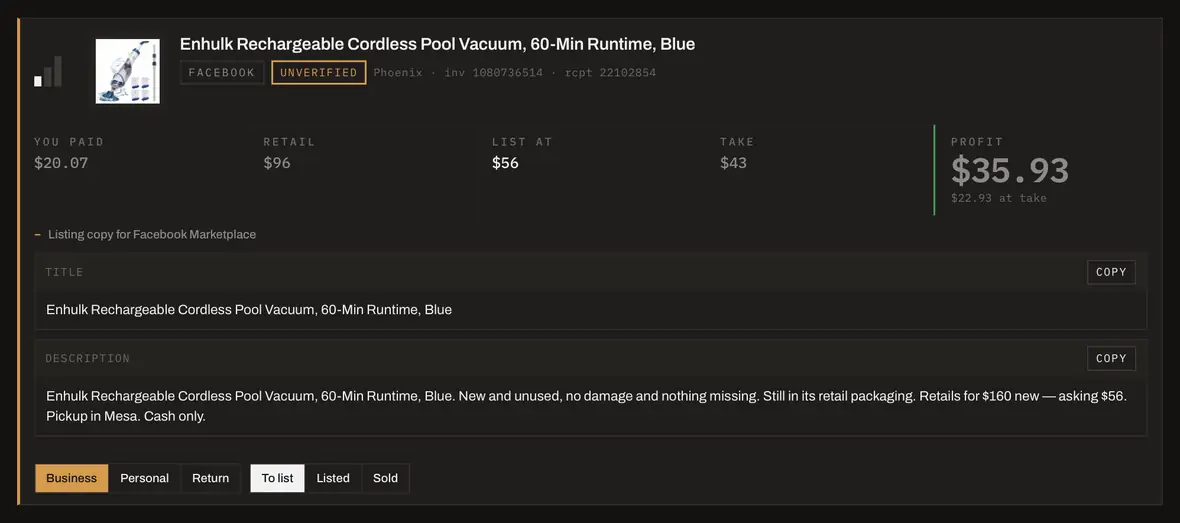 One lot, all the way through. What you paid, what it retails for, what to list it
at, what you will take, what you keep — and the listing already written, title
and description, ready to paste.
And it keeps score afterwards. Look at the red line across the top of that screen:
three lots that cannot earn back what they cost, and the money sitting in them. A tool
that only ever tells you good news is not telling you anything — the point is to find
that out in week two rather than month six.
What you get
One membership. Four parts, all included, no upsell behind any of them.
The method
The course
How to read a lot, what the fees really cost you, how to set a ceiling and hold it,
how to write a listing that sells, and how to run returns so the window never closes on you.
The tool
The sourcing desk
Every open lot in your warehouse, scanned and priced against real retail, with a hard
maximum bid worked out after premium and tax. Plus the ledger that tracks what you paid,
what you sold it for and what you actually made.
The room
A call every week
Weekly, not monthly. Bring the lot you are unsure about, the listing that is not moving,
or the invoice you think you overpaid on. Plus other people buying in their own markets,
so you find out what is selling before you spend money learning it.
The line
Text me directly
Founding members get my cell. Send me a lot and I will tell you what I would bid
— up to ten a day, every day. Everyone else gets fifteen in their first month,
which is enough to get the first few buys right.
What $500 of stock actually does
Not a projection off one good week. This is the pace a disciplined buyer hits
when returns are reinvested through the early months.
Month one
$500–1,000
From $500 in product, bought carefully and turned over rather than hoarded.
By month three
$1,200–2,500
Same $500, compounded. The stake stops being the constraint.
By month nine
Full time
Past this point the limit is hours in the day, not money to deploy.
Other people will promise you tens of thousands in month one. We would rather give you a
number you can actually hit — and have you a little excited every month for nine
months, than excited once at checkout and quietly out by month six.
These figures describe the pace of one operator's completed sales and the
reinvestment plan taught in the course. They are a target under stated conditions, not a
promise, not an average, and not typical. What you make depends on your market, your hours,
what you buy and what you pay for it. Plenty of people will make less. Some will make nothing.
All of this, for $57 a month
Your warehouse alone had
tens of thousands of lots open when this page loaded. At three
seconds each — long enough to read a title and glance at a price — that is
dozens of hours of reading. Every night. Before you have bid
on anything.
The course
The whole method, start to first sale.
$297 once
The sourcing desk
Your warehouse scanned nightly, every lot priced against what it really
sells for, a hard ceiling on each one.
$89 / mo
A call every week
Four live hours a month with your own lots on the screen.
$120 / mo
Ten deal checks a day
Text me a lot, I tell you what I would bid. A minute of my time each, three
hundred of them a month, at $2.75 a check. Founding members only.
$825 / mo
Listings written for you
Title, description and photos for every lot you win.
$30 / mo
What that comes to
$1,064 / mo + $297
What you pay
$57 / mo, nothing up front
Those are what I think each piece is worth, not retail prices invented
to make the discount look bigger. If you want an outside number: bundled sourcing software
for resellers starts around $69 a month on its own, and not one of those tools will price
a liquidation lot for you or tell you what to stop buying.
—
$57
/ month
$97
Your price is locked for as long as you stay a member. Cancel any time
— but if you leave and come back, you come back at the going rate.
Billed monthly through Skool · cancel any time
Two ways out. One of them pays you.
I would rather you try it properly and leave up than sit on the fence
for a month.
125% backwithin 30 days
Buy one lot and list it on Facebook. If you still want out inside your first 30 days,
I send back 125% of your first month. You keep everything you learned and you leave
with more than you came in with.
Proof is two screenshots: your Nellis receipt and the live Facebook
listing. One claim per person, on the first month only. The extra 25% comes by Venmo.
100% backwithin 15 days
Didn't get to it? That happens. Ask inside 15 days and you get the whole thing back,
no screenshots and no questions.
Start with one lot
The first flip teaches you more than any video will. The community is where you
learn what to do with the second.